How to Wake Up Early (Without Hating Every Morning)
How to wake up early as a teen: why it's so hard, how much sleep you need according to the CDC and AASM, and a plan that starts the night before.


In this guide
- Why is it so hard for teens to wake up early?
- How much sleep do teens need?
- What time should I go to bed? A quick chart
- How to wake up early: the plan
- What to do the second your alarm goes off
- What doesn’t work
- What if I sleep enough and still can’t wake up?
- Is school starting too early? What you can do
- Questions people ask
To wake up early, you have to go to sleep earlier. That’s the boring truth, and it’s the part most “5 a.m. morning routine” videos skip. An alarm only gets you out of bed. Enough sleep is what makes you feel human once you’re up.
The good news is that being a zombie at 6:30 a.m. isn’t a personal flaw. There’s real biology behind it, and there are small things that make mornings easier. Here’s the plan.
Why is it so hard for teens to wake up early?
Because your body clock changed. KidsHealth explains that during the teen years your internal sleep clock resets to fall asleep later at night, and teen brains make the sleep hormone melatonin later than kids’ and adults’ brains do. Bright light and blue light from screens push melatonin even later.
So at 10 p.m. you might not feel sleepy yet. Then school starts early anyway. The CDC puts it plainly: the combination of late bedtimes and early school start times results in most adolescents not getting enough sleep.
It’s not laziness. It’s a clock that runs late meeting a schedule that doesn’t.
How much sleep do teens need?
The CDC lists 8 to 10 hours a day for ages 13 to 17. The American Academy of Sleep Medicine (AASM) recommends the same range, 8 to 10 hours per 24 hours on a regular basis, for ages 13 to 18.
Most teens aren’t getting that. In CDC’s 2025 survey, about 1 in 4 high school students got at least 8 hours of sleep on an average school night. By grade, that was 31% of 9th graders and 20% of 12th graders. If you’re tired, you have a lot of company.
Why it matters: the AASM says regularly getting less sleep than recommended is linked to attention, behavior and learning problems. The CDC adds that too little sleep can make concentrating harder and affect mental health.
What time should I go to bed? A quick chart
KidsHealth has a simple method: take the time you have to wake up and count back at least 8 hours. Remember that you also need time to fall asleep, so bed means lights out and phone away, not just lying there scrolling.
| If you wake up at | 8 hours: lights out by | 9 hours: lights out by | 10 hours: lights out by |
|---|---|---|---|
| 6:00 a.m. | 10:00 p.m. | 9:00 p.m. | 8:00 p.m. |
| 6:30 a.m. | 10:30 p.m. | 9:30 p.m. | 8:30 p.m. |
| 7:00 a.m. | 11:00 p.m. | 10:00 p.m. | 9:00 p.m. |
Your sleep need can be a bit different from your friend’s, so use this as a starting point. If you wake up before the alarm feeling fine, you’re probably in a good spot.
How to wake up early: the plan
1. Fix the bedtime first
If your alarm is at 6:30 and you go to bed at midnight, no trick will save you. Pick a lights-out time from the chart above and treat it like an appointment.
2. Move it gradually
Going from 12:30 a.m. to 10:30 p.m. overnight rarely works, because your body isn’t ready. Try moving your bedtime and your alarm 15 minutes earlier every few days until you reach your goal. There’s no magic number, but small shifts are easier to stick with than a big jump.
3. Keep the same wake-up time every day
The CDC recommends a regular bedtime and wake-up time, including on weekends. KidsHealth says the same: stick to the schedule as close as you can, even on weekends. Big weekend swings make it harder to keep your clock steady, which can be part of why Monday feels so brutal. A little extra sleep is fine. A four-hour swing makes things harder.
4. Use light on purpose
According to the National Institute of General Medical Sciences, light and dark have the biggest influence on circadian rhythms, and light from electronic devices at night can confuse your biological clock. So the logic is simple: dim the lights and put screens down in the evening, and open the curtains or turn on bright lights as soon as you’re up.
5. Put the screens away before bed
The CDC recommends turning off electronic devices at least 30 minutes before bedtime. KidsHealth suggests about an hour before bed. Pick whichever you can actually stick to, and charge your phone across the room. That also makes it a lot harder to hit snooze, and it helps with doomscrolling at 11 p.m.
6. Watch the caffeine
The CDC says to avoid caffeine in the afternoon or evening, and KidsHealth says late afternoon and evening. KidsHealth lists coffee, tea, soda, energy drinks and chocolate. If you need a 4 p.m. boost, try water, a snack or a walk instead.
7. Make your room sleep-friendly
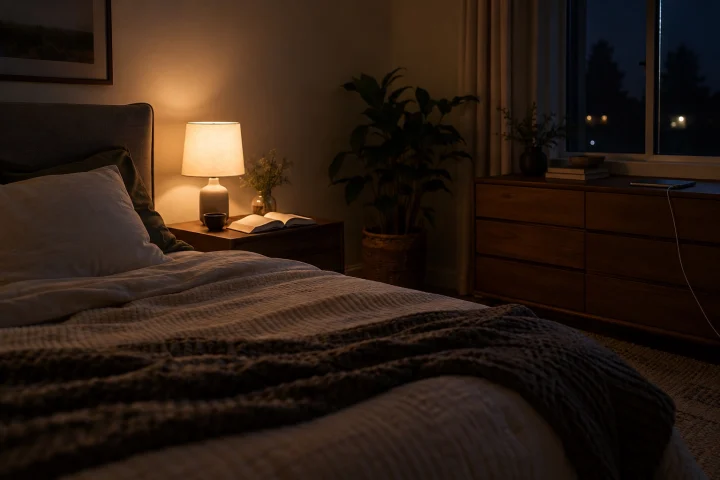
KidsHealth recommends keeping the bedroom dark, cool and quiet, and a relaxing routine like a warm shower before bed.
What to do the second your alarm goes off
- Sit up and put your feet on the floor. Don’t “just check” your phone in bed.
- Turn on a bright light or open the curtains.
- Drink a glass of water.
- Do one small thing right away: brush your teeth, wash your face or change clothes.
Set yourself up the night before to make this easier. Pick an outfit, pack your bag, and plan breakfast. Our 30-minute morning routine for school has the full version.
What doesn’t work
- Staying up late and fixing it with coffee. That just moves the problem to the evening.
- Setting ten alarms. One alarm across the room beats ten you can snooze.
- Sleeping until noon on Saturday. It feels great, but it works against the steady schedule you’re trying to build.
- Copying someone else’s 5 a.m. routine. You don’t need to wake at 5. You need to wake at a time that works for your school, your sleep need and your schedule.
What if I sleep enough and still can’t wake up?
Sometimes the cause isn’t your habits. The CDC lists trouble falling asleep, repeatedly waking up during the night, and feeling sleepy or tired even after getting enough sleep among the signs you may not be getting good quality sleep. If that sounds like you for weeks, tell a parent and ask about seeing a doctor. They can check for things you can’t fix with an alarm.
Is school starting too early? What you can do
You’re not imagining it. The CDC notes that in 2014 the American Academy of Pediatrics recommended that middle schools and high schools start no earlier than 8:30 a.m. A school’s start time usually isn’t something one student can change quickly.
But you can bring it up. Ask your student council whether they’ve talked about it, or ask a parent how families can share their views with your school or district. In the meantime, a steady bedtime is the one part of this you control. Better sleep also helps with getting good grades and keeps you from falling apart before a test, so here’s also how to study for a test without staying up until 2 a.m.
Lying awake with a racing brain? That’s a different problem with different fixes. Start with how to stop overthinking.