Benzoyl Peroxide vs Salicylic Acid: Which One Your Breakouts Actually Need
One fights red, angry pimples. The other unclogs blackheads. Here's how to tell which kind of breakout you have and how to use each without frying your skin.

In this guide
Standing in the skincare aisle, every acne product seems to say one of two things on the label: benzoyl peroxide or salicylic acid. They both fight acne, but they don’t do the same job. Picking the right one depends on what your breakouts actually look like.
Quick version: red, swollen pimples, try benzoyl peroxide. Blackheads and little clogged bumps, try salicylic acid. Here’s why, and how to use them.
What benzoyl peroxide does
Benzoyl peroxide kills the acne bacteria that live in clogged pores and make pimples red and swollen. According to the American Academy of Dermatology (AAD), it’s especially good for mild pimples, the red bumps and the ones with a white or yellow top.
- Best for: red pimples, pimples with pus, breakouts on the back and chest
- Comes as: face washes, gels, creams and spot treatments, usually 2.5% to 10%
- Downsides: it can dry out and irritate your skin, and it bleaches fabric
What salicylic acid does
Salicylic acid gets into pores and loosens the oil and dead skin clogging them. It’s a gentle exfoliant, so it’s great for blackheads and whiteheads, the small bumps that aren’t red and angry yet. It also helps calm some inflammation.
- Best for: blackheads, whiteheads, rough or bumpy texture, oily skin
- Comes as: face washes, toners, pads and leave-on treatments, usually 0.5% to 2%
- Downsides: can sting or dry you out if you use too much, and it’s gentler on red pimples than benzoyl peroxide
Which one do you need?
| Your skin | Try first |
|---|---|
| Blackheads on your nose and chin | Salicylic acid |
| Tiny skin-colored bumps, rough texture | Salicylic acid |
| Red pimples, some with white tops | Benzoyl peroxide |
| Breakouts on your back or chest | Benzoyl peroxide wash |
| A bit of everything | One of each, at different times of day |
| Deep, painful bumps that last weeks | A dermatologist |
For blackheads and whiteheads, the AAD also recommends a retinoid like adapalene (sold over the counter as a gel) along with a benzoyl peroxide wash. That’s a good next step if salicylic acid alone isn’t enough.
Can you use benzoyl peroxide and salicylic acid together?
Yes, and lots of people do. The trick is not to pile them on at the same time, because together they can dry your skin out fast. A simple way to split them:
- Morning: salicylic acid cleanser, moisturizer, sunscreen
- Night: benzoyl peroxide wash or a thin layer of benzoyl peroxide gel, then moisturizer
If your skin gets tight, flaky or stings, cut back to one product every other day and build up again slowly.
How to use them without wrecking your skin
- Start with one product. If you add two at once and your face gets irritated, you won’t know which one did it.
- Use a little. A thin layer is enough. More doesn’t work faster, it just irritates more.
- Always moisturize. Even oily skin needs it, especially with acne products. Dry, irritated skin can break out more.
- Wear sunscreen in the morning. Acne treatments can make your skin more sensitive.
- Be patient. The AAD says to give a new acne routine 6 to 8 weeks. Most products barely change anything in the first two.
What about benzene in benzoyl peroxide?
You might have seen headlines about benzene, a chemical that can cause cancer, showing up in some benzoyl peroxide products. In 2025, the FDA tested 95 acne products and found more than 90% had undetectable or extremely low levels. A small number of batches had higher levels and were recalled. The FDA says that even with daily use for decades, the cancer risk from these products is very low.
The AAD’s advice if you want to be extra careful: store benzoyl peroxide at room temperature or cooler, don’t leave it in a hot car, throw it out if it’s been somewhere hotter than 78°F, and replace it every 10 to 12 weeks. If you’d rather skip it, ask a dermatologist about other options like adapalene, salicylic acid or azelaic acid.
When to see a dermatologist
Ask a parent to book an appointment if:
- You’ve used a routine for 6 to 8 weeks and nothing’s better
- You get deep, painful bumps under the skin
- Your acne leaves dark marks or scars
- It’s making you not want to go to school or see people
Dermatologists have prescription treatments that work much better for stubborn or deep acne. Going isn’t overreacting.
Just starting out? A tracker makes it easier to stick with a routine long enough to see results.
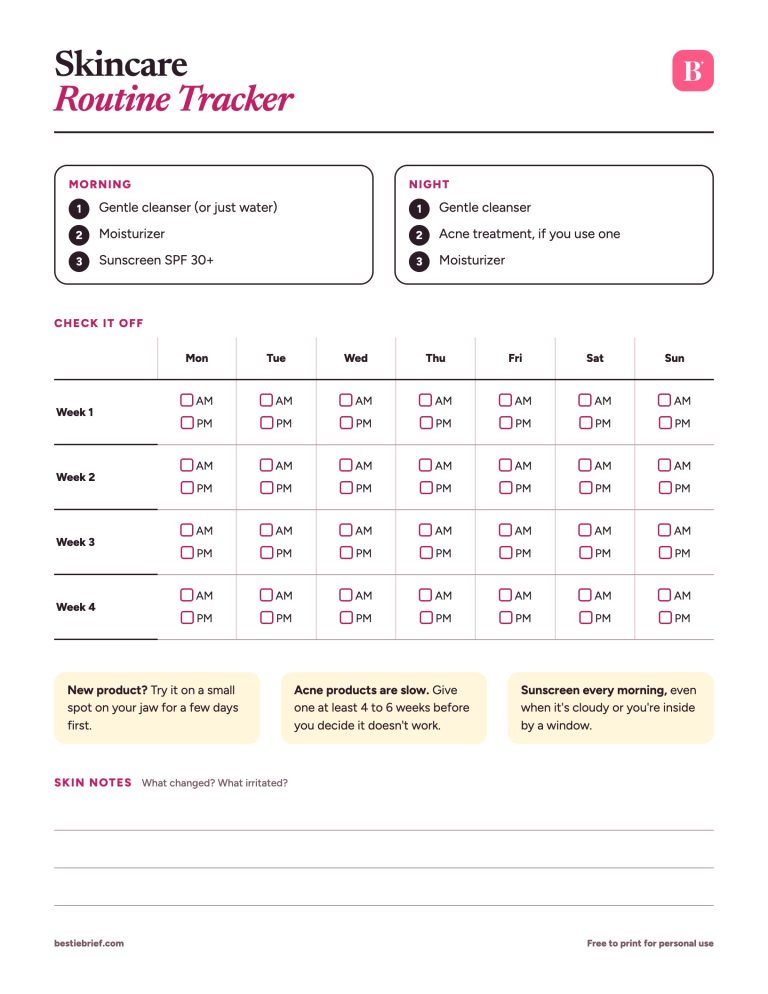
My First Skincare Routine Tracker
Three steps in the morning, three at night. Tape it next to your mirror and check off every day for four weeks.
Download the PDFOne page, letter size, prints fine in black and white.And for that one pimple that showed up the night before picture day, read whether pimple patches actually work.