Your First Skincare Routine: 3 Steps, No Retinol Required
Three steps in the morning, three at night, nothing anti-aging. The simple routine dermatologists recommend for teens, plus what to add if you break out.


In this guide
You don’t need a 10-step routine, a $60 serum or anything with “anti-aging” on the label. A good teen skincare routine is three steps in the morning and three at night, and most of it costs about what you’d spend on lunch.
This is the routine dermatologists actually tell teens to start with, plus how to tweak it if your skin is oily, dry or breaking out.
The 3-step skincare routine for teens
The American Academy of Dermatology keeps it simple: wash with a gentle cleanser, use a fragrance-free moisturizer, and wear a broad-spectrum, water-resistant sunscreen. That’s it. Everything else is optional.
Morning
Short on time? It fits into this 30-minute morning routine for school.
- Cleanser (or just water). If your skin isn’t oily in the morning, a splash of lukewarm water is fine.
- Moisturizer. A light, fragrance-free one.
- Sunscreen, SPF 30 or higher. Every day, even when it’s cloudy. If your moisturizer already has SPF 30, that counts as steps 2 and 3 together.
Night
- Cleanser. This one matters more, because it takes off sunscreen, sweat and the whole day.
- Acne treatment, only if you need one. A thin layer on the areas that break out.
- Moisturizer. Yes, even if you’re oily.
Step 1: Cleanser
Look for words like “gentle,” “non-foaming” or “for sensitive skin,” and skip anything with scrubby bits. The AAD’s advice for acne-prone skin is to wash up to twice a day and after sweating, using your fingertips. Washcloths, sponges and face brushes can irritate your skin, and so can scrubbing harder.
Washing more than twice a day doesn’t make skin cleaner. It just makes it drier and redder, and oily skin often answers by making more oil.
Step 2: Moisturizer
This is the step teens skip most, especially with oily skin. Don’t. A moisturizer keeps your skin barrier healthy, and if you use an acne product, it helps your skin put up with it instead of getting flaky and red.
- Oily skin: a gel or lotion labeled “oil-free” and “non-comedogenic” (that means it’s made not to clog pores).
- Dry skin: a thicker cream. Put it on while your skin is still a little damp.
- Sensitive skin: fragrance-free, short ingredient list.
Not sure which one you are? Take the skin type quiz.
Step 3: Sunscreen
The AAD recommends three things on the label: SPF 30 or higher, broad spectrum (protects from both UVA and UVB rays) and water resistant. If you break out easily, also look for “non-comedogenic” or “won’t clog pores.”
Sunscreen is the real anti-aging product, and it also stops red and dark marks from old pimples from getting darker in the sun. If yours feels greasy, try a gel or fluid texture before giving up on sunscreen completely.
What about acne?
If you get breakouts most weeks, add one acne treatment at night. Two of the most common ones you can buy without a prescription:
- Benzoyl peroxide for red, inflamed pimples.
- Salicylic acid for blackheads and clogged pores.
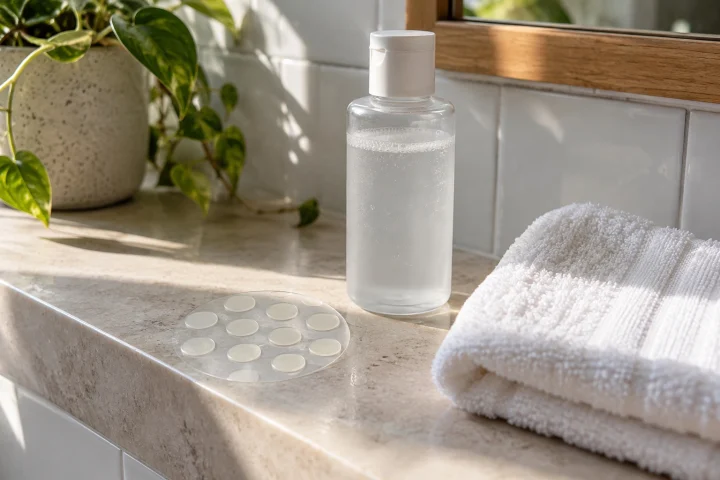
Not sure which one is yours? We compared them in benzoyl peroxide vs salicylic acid. For a single pimple that pops up before picture day, a pimple patch can help overnight.
Pick one treatment, not three. Then give it time. Acne products are slow: the AAD says it can take several weeks to a few months to see a difference, so plan on at least 4 to 6 weeks before you decide something doesn’t work.
Do teens need retinol?
Most don’t. Retinol, vitamin C and exfoliating acids are made for wrinkles, sun damage and uneven tone, and a dermatologist quoted by the AAD lists them as things tweens and teens can skip. On young skin they mostly cause dryness, peeling and redness.
Acne is a different story. Adapalene is a retinoid for acne, and the FDA approved it in 2016 for over-the-counter use for people 12 and older. If benzoyl peroxide or salicylic acid isn’t helping after a couple of months, it’s worth asking a parent or a doctor about. It can be irritating at first, so it’s not a “just add it” product.
How to try a new product without a breakout
Add one new product at a time, and wait about two weeks before adding another. That way, if your skin gets angry, you know who did it.
The AAD’s test for new products: put a small amount on the inside of your elbow twice a day for 7 to 10 days. No redness, itching or swelling? Go ahead and use it on your face.
What you can skip
- Toners, astringents and scrubs. The AAD says they can irritate acne-prone skin.
- Anything with strong fragrance, especially if your skin is sensitive.
- Products sold for wrinkles, dark spots or “anti-aging.”
- A 10-step routine you saw on someone else’s face. More steps means more chances for irritation, not better skin.
- Expensive versions. A drugstore cleanser and moisturizer can do the same job as a $50 one.
When to see a dermatologist
Ask a parent about a dermatologist if your acne hurts, leaves marks or scars, or doesn’t get better after a couple of months of a steady routine. Same if it makes you not want to go to school or be in photos. Prescription treatments work well, and you don’t have to wait until it’s “bad enough.” Meanwhile, these 7 boring habits for clear skin help any routine work better.
Free printable tracker
The hardest part of a routine is the first month. Tape this next to your mirror and check off morning and night for four weeks.
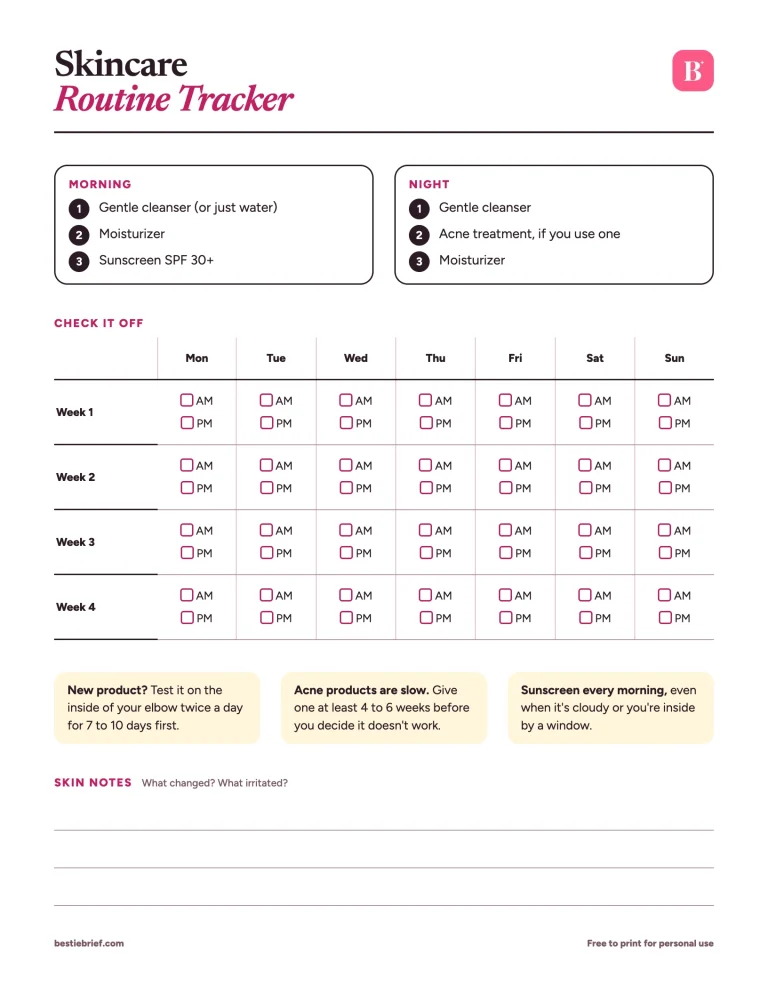
My First Skincare Routine Tracker
Three steps in the morning, three at night. Tape it next to your mirror and check off every day for four weeks.
Download the PDFOne page, letter size, prints fine in black and white.