Back Acne: What Actually Clears It (and What to Stop Doing)
How to get rid of back acne: the daily wash dermatologists recommend, habits that keep it going, how long it takes, and when to see a doctor.


In this guide
The fastest way to get rid of back acne is a benzoyl peroxide wash, used every day, left on your back for a couple of minutes before you rinse. It is not instant, but it is the thing dermatologists actually point to.
Back acne (a lot of people call it “bacne”) is annoying in a special way. You can’t see it, you can’t reach it, and you still know it’s there every time you put on a tank top. Here’s the plan that works, step by step, plus the habits that quietly keep it going.
Why you get acne on your back
Back acne is the same thing as face acne: pores that get clogged. Whiteheads are clogged pores that stay closed. Blackheads are clogged pores that stay open, and the American Academy of Dermatology (AAD) points out those black dots aren’t dirt, so you can’t scrub them away.
The skin on your back is thicker than the skin on your face, which makes medicine slower to get in. That’s why back acne needs a slightly different game plan, and a lot more patience. If you want the full-body picture first, start with 7 habits for clear skin.
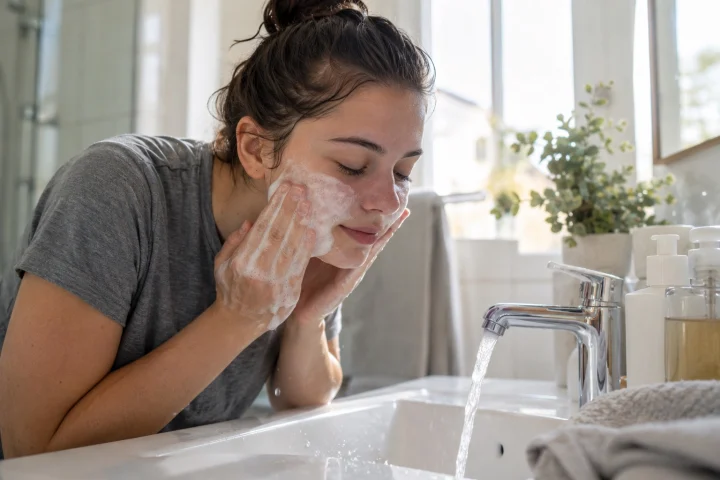
Step 1: Use a benzoyl peroxide wash (and leave it on)
The AAD says mild back acne, acne that just showed up, and moderate acne (a mix of whiteheads, blackheads and pimples that isn’t deep or painful) can often be treated at home. Their back acne page starts with a foaming benzoyl peroxide wash you can buy without a prescription.
Here’s how to use it the way the AAD describes:
- Use it daily in the shower. Benzoyl peroxide kills acne-causing bacteria, and daily use helps control flare-ups.
- Leave it on for two to five minutes. The AAD says “studies show that benzoyl peroxide works best if left on the back for two to five minutes.” Wash your hair and your legs first, then rinse your back last.
- Rinse well. Benzoyl peroxide can bleach clothes, sheets and towels.
- Start gentle. A wash with 5.3% benzoyl peroxide is less likely to cause irritation, dryness or peeling. If you feel like you need more, the AAD says you can start with a 10% foaming wash, the strongest you can get without a prescription.
Not sure whether you need benzoyl peroxide or salicylic acid? We broke down the difference in benzoyl peroxide vs salicylic acid.
Step 2: Add a gel for clogged pores
For stubborn bumps, the AAD says adapalene 0.1% gel, a retinoid you can also buy without a prescription, can be used with the benzoyl peroxide wash to help unclog pores. You apply it daily, after your shower or before bed.
Retinoids can dry and irritate skin, so ask a parent, a pharmacist or your doctor before adding one, especially if your skin is sensitive. One more tip from the AAD: a back lotion applicator (a long handle with a sponge pad) helps you reach your whole back without twisting into a pretzel.
What to stop doing to your back
This is the part most people skip, and it’s why they plateau. The AAD says to avoid:
- Scrubbing. Scrubbing makes acne worse, not better.
- Loofahs, back brushes, buff puffs and abrasive scrubs. The AAD lists them as things to skip.
- Antibacterial soaps and astringents. Too harsh. Choose gentle, fragrance-free products instead.
- Popping or picking. The AAD says popping pimples at home can cause permanent scars, more noticeable and more painful acne, and infection.
- Heavy body products. Look for labels like “non-comedogenic,” “oil-free” or “won’t clog pores” on lotions and sunscreen.
Also skip the routine-hopping. The AAD says to give an acne treatment at least four weeks to work, and that trying too many products at once can stress your skin and make acne worse. One or two products is plenty.
Sweat, workouts and backpacks
If your back breaks out around sports season, this section is for you. The AAD’s advice:
- Shower and change clothes as soon as you can after a workout or anything that makes you sweat. If you can’t shower right away, wipe your back with an oil-free cleansing wipe.
- Wash workout clothes after every use.
- Wear loose clothing made of cotton or a sweat-wicking fabric during workouts.
- Pat sweat dry. The AAD says roughly rubbing sweat away with a towel can irritate skin and cause breakouts. Pat it instead.
- Cut down on rubbing. Backpacks and other things that rub your back can make it worse. Try a handheld bag or carry your purse on your arm for a while.
Changing your sheets regularly is a good habit too, though the AAD page doesn’t set a schedule for it, so take that one as common sense, not a rule.
Does sun help back acne?
No. This is a popular belief, and the AAD says it’s wrong: sun exposure can darken acne marks and make them last longer. Wear sunscreen on every part of your back that clothing doesn’t cover. The AAD recommends a non-comedogenic, broad-spectrum, water-resistant sunscreen with SPF 30 or higher. Dark marks that stick around are a different problem, and we cover them in how to get rid of acne scars.
How long until back acne clears?
Longer than you want. The AAD says that if your treatment is working, you may see results in 6 to 8 weeks, and complete clearing can take 3 to 4 months. That timeline is the whole reason people give up too early.
Take a photo of your back in the same light on day one and again at week six. You can’t see your own back in the mirror every day, so the photo is how you’ll know it’s working. Want the full-body routine? See our skincare routine for teens.
When to see a dermatologist
Go earlier than you think you need to if any of these are true:
- Your back acne is deep or painful. The AAD says that kind needs a dermatologist’s help.
- You have cysts or nodules, which are deep blemishes that can leave scars.
- You’ve used a treatment for 6 to 8 weeks with no difference. The AAD says to see a dermatologist at that point.
- You’re not sure it’s acne at all. A doctor can tell you what you’re dealing with.
The AAD also says virtually every type of acne can be treated successfully with a dermatologist’s help, so you don’t have to just live with it. Ask a parent or guardian to book the visit, or read how to make a doctor’s appointment if you want to do it yourself. Prescription treatments are a conversation for that visit, not something to guess at.