How to Get Rid of Acne Scars (and Tell If It’s Even a Scar)
Most marks after a pimple aren't scars and fade on their own. How to tell the difference, how to stop new scars and what a dermatologist can do for real ones.


In this guide
The pimple is finally gone, but it left something behind: a dark spot, a red mark or a little dent that won’t go away. You want to know how to get rid of it, fast.
First, the good news: a lot of what people call “acne scars” aren’t scars at all, and they fade on their own. Below: how to tell what you have, what you can do at home and when to see a dermatologist.
Scar or spot? Check this first
The American Academy of Dermatology (AAD) separates two very different things:
| Flat spot (PIH) | Acne scar | |
|---|---|---|
| What it feels like | Flat, smooth skin | A dent, or a raised bump |
| What it looks like | Red or pink on lighter skin, brown or bluish gray on medium and darker skin | Uneven texture, sometimes with some color |
| Does it go away? | Usually fades over time, no trace left | Can fade, but rarely goes away completely on its own |
That flat spot is called post-inflammatory hyperpigmentation (PIH). The AAD says these spots are usually not scars, and that fading can take time. Run a finger over the spot: if the skin is smooth, you’re most likely dealing with PIH.
The types of real acne scars
When skin heals after a breakout, it makes collagen. Too little collagen leaves a dent, too much leaves a bump. According to the AAD:
- Ice pick scars: small but deep. The most common type.
- Boxcar scars: round or oval dents, wider than ice pick scars.
- Rolling scars: wide and shallow, can make skin look wavy.
- Raised scars: firm bumps, more common in people with darker skin tones. Keloids are a type that grows bigger than the original breakout.
Most people with acne scars have the dented kind, often more than one type.
How to stop new scars from forming
This part is the most important, because preventing a scar is much easier than treating one. The AAD’s advice:
- Treat acne early. Mild acne treated with over-the-counter products is less likely to turn into the deep breakouts that scar.
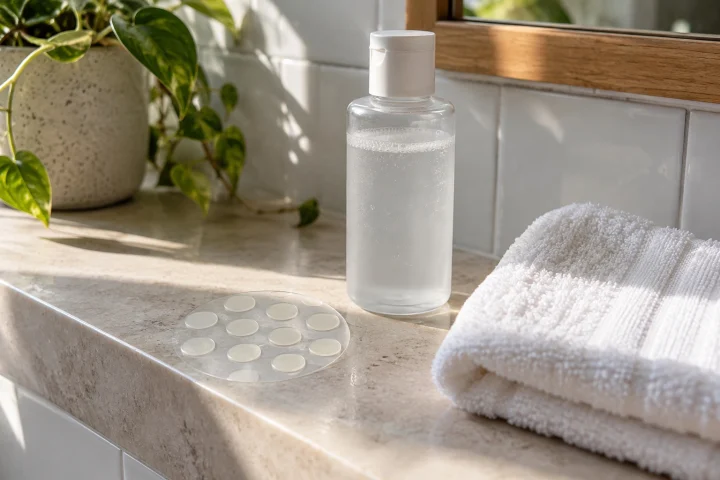
- Never pick, pop, scratch or squeeze. It increases inflammation, and more inflammation means a bigger chance of a scar. A pimple patch can help keep your hands off.
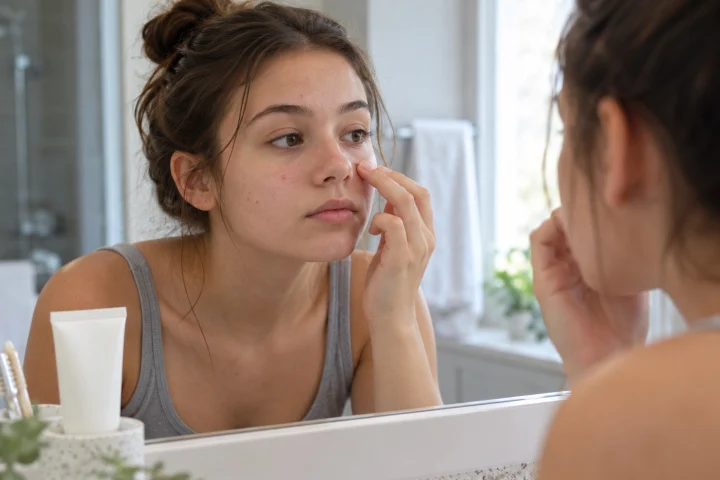
- Stop touching your acne. Touching can make it worse, and worse acne is more likely to scar.
- Know your risk. You’re more likely to scar if you get deep, painful acne or if a parent or sibling has acne scars. If that’s you, it’s worth seeing a dermatologist early.
Not sure where to start with acne treatment? See benzoyl peroxide vs. salicylic acid and our simple skincare routine for teens.
What you can do at home
For flat dark or red spots
- Be patient. PIH usually fades on its own over time.
- Keep your acne under control, so new spots don’t keep replacing the old ones.
- Wear sunscreen every day as part of your routine.
- Don’t scrub them. Harsh scrubs irritate skin, and irritation means more inflammation.
If the spots bother you, the AAD says a dermatologist can recommend treatment to help them fade faster.
For mild scars
The AAD says that for mild acne scarring, a retinoid or salicylic acid applied to the skin can make scarring less noticeable. Adapalene is an over-the-counter retinoid for ages 12 and up, but talk to a parent or doctor before adding it, and expect it to take time.
What a dermatologist can do
For real scars, the AAD says the best results usually come from a board-certified dermatologist, who will first get your acne under control and then pick treatments for your type of scar. Options include:
- Chemical peels, often several sessions a few weeks apart
- Laser treatment to resurface the skin
- Microneedling, which the AAD says is safe for all skin tones
- Fillers that lift dented scars, usually temporary
- Minor scar surgery for deeper scars
- Different treatments for raised scars, since those come from too much collagen
One thing to know before you ask: the AAD notes that medical insurance doesn’t cover the cost of acne scar treatment. Dermatologists also usually start treating scars only once your acne is under control.
If your acne is deep and painful right now, that’s the time to see a dermatologist, before it scars. Here’s how to make a doctor’s appointment.
How you feel about it matters too
The AAD suggests asking yourself whether your scars make you wish you could change them, or make you less outgoing than before. If the answer is yes, talking with a dermatologist can help. And if you notice scars bothering you way more than anyone else seems to notice them, that’s really common too. Most people are looking at their own skin, not yours.