Coping Skills for Bad Days: A List to Screenshot
Calm your body, come back to right now, get through the next hour, let it out. Coping skills for hard moments, plus a free printable list.


In this guide
Some days are just bad. A fight with a friend, a test that went wrong, a feeling you can’t even name. In the moment, “just calm down” is useless advice. What helps is having a list ready of things to actually do.
These are coping skills: small, practical things that help you get through a hard moment without making it worse. Screenshot this list, or print the free version at the bottom.
How to use this list
- Try them on an okay day first. It’s much easier to find out what works for you when you’re not already overwhelmed.
- Not everything works for everyone. Breathing exercises are a game changer for some people and do nothing for others. That’s normal. Keep the ones that work and skip the rest.
- Start with your body. When feelings are really big, thinking your way out is hard. Calming your body first often makes the rest easier.
Coping skills to calm your body
For when your heart is racing, you’re shaking or you feel like you might explode.
- Cold water. Splash cold water on your face or hold an ice cube in your hand.
- Slow breathing. Breathe in for 4 counts, out for 6. Do it five times.
- Move. Twenty jumping jacks, a fast walk around the block, dancing to one loud song.
- Squeeze and let go. Make tight fists for 5 seconds, then let go. Try it with your shoulders and your feet too.
- Get heavy. Wrap up in a heavy blanket or lie on the floor.
- Drink a full glass of water.
Coping skills to come back to right now
For when your thoughts are spinning or you feel far away from what’s around you. These are called grounding skills.
- 5-4-3-2-1. Name 5 things you see, 4 you can touch, 3 you hear, 2 you smell and 1 you taste.
- Color hunt. Find everything blue in the room. Then everything red.
- Describe something. Hold something cold or bumpy and describe it in detail, out loud or in your head.
- Say the facts. Say where you are, what day it is and what you’re doing, out loud.
- Feet on the floor. Put both feet flat on the ground and press down. Notice how the floor feels.
Coping skills to get through the next hour
For when you just need time to pass until the feeling gets smaller.
- Take a shower with music on.
- Watch one episode of your comfort show.
- Clean or organize one small thing, like your desk or a drawer.
- Doodle, color or do a puzzle.
- Go outside for 10 minutes.
- Make yourself a snack, even a simple one.
- Pet an animal, or watch videos of them.
Coping skills to let it out
For when the feeling needs to go somewhere.
- Write it all down, then rip it up. Need a place to start? Try these journal prompts for when your head is too loud.
- Cry. It’s allowed, and for a lot of people it helps.
- Record a voice memo to yourself about what happened.
- Text someone: “Rough day, can you talk?” You don’t have to explain everything.
- Hug a pet or a pillow.
Coping skills with people
Coping isn’t only something you do alone. Some of the strongest coping skills involve other people:
- Sit with a family member while they cook or watch TV, even without talking.
- Call a friend and talk about anything except what’s wrong.
- Tell a trusted adult, like a parent, teacher, coach or school counselor, that you’re having a hard time. If you think talking to a professional would help, here’s how to tell your parents you want a therapist.
Healthy vs. unhealthy coping
Everyone copes somehow. Some ways help you feel better for a while and then make things worse. Signs a coping habit isn’t helping:
- You feel worse, guilty or more alone after.
- It hurts your body, your sleep, your grades or your friendships.
- You need more and more of it to feel okay.
- You have to hide it.
Scrolling for hours is a common one. It numbs the feeling, but it rarely fixes it. Here’s how to stop doomscrolling.
Free printable coping skills list
Print it, check the ones that work for you and stick it on your wall. There’s space at the bottom for the people you can text.
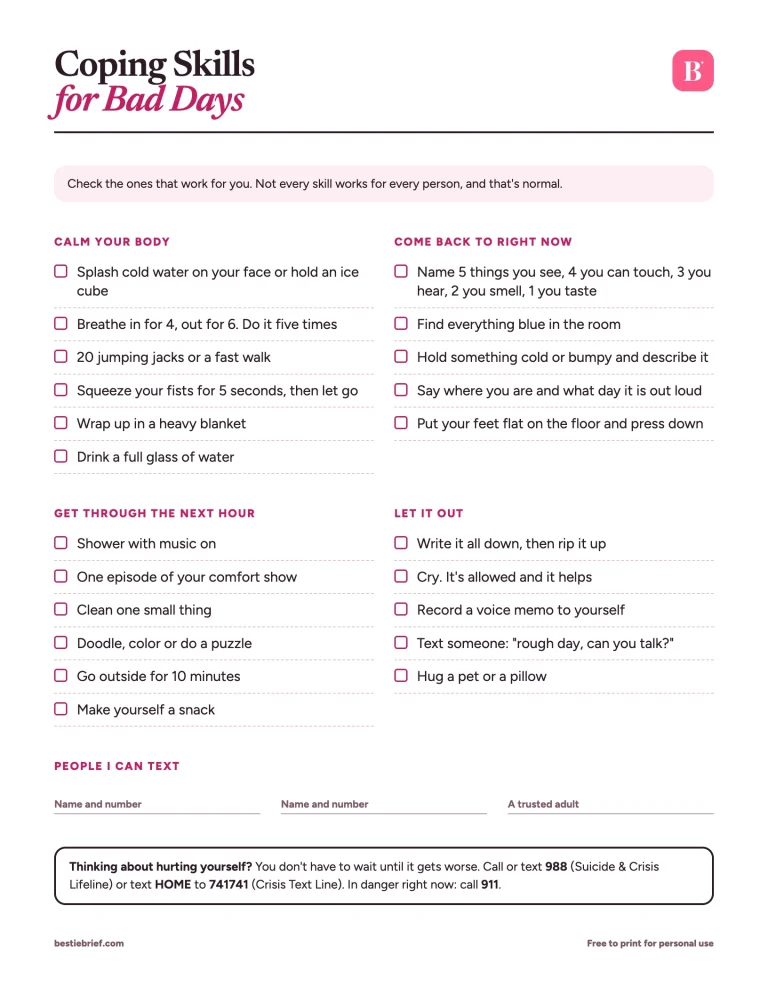
Coping Skills for Bad Days
A list to stick on your wall or keep in your phone. Try a few on an okay day, so you know which ones work before a hard one.
Download the PDFOne page, letter size, prints fine in black and white.