Clear Skin Isn’t a Secret Product. It’s These 7 Boring Habits
The habits dermatologists actually recommend, from how often to wash to how long to give a treatment, plus what the science says about food and acne.


In this guide
- 1. Wash your face twice a day, gently
- 2. Keep your hands off your face
- 3. Wear sunscreen every morning
- 4. Use products that won’t clog pores
- 5. Wash what touches your face
- 6. Moisturize, even if you’re oily
- 7. Pick one treatment and stick with it
- What about food?
- When to see a dermatologist
- Free printable tracker
- Questions people ask
Every week there’s a new “holy grail” product that promises clear skin. Most of them do very little on their own. The people with clear skin usually aren’t using a secret serum. They’re doing a few boring things, every single day.
Here are the 7 habits dermatologists actually recommend, and why they work better than anything trending.
1. Wash your face twice a day, gently
The American Academy of Dermatology says to wash twice a day, when you wake up and before bed, plus after you sweat. More than that can irritate your skin and make acne worse.
Use a mild cleanser and your fingertips. No scrubs, no washcloths, no rough rubbing. Pat dry with a clean towel.
2. Keep your hands off your face
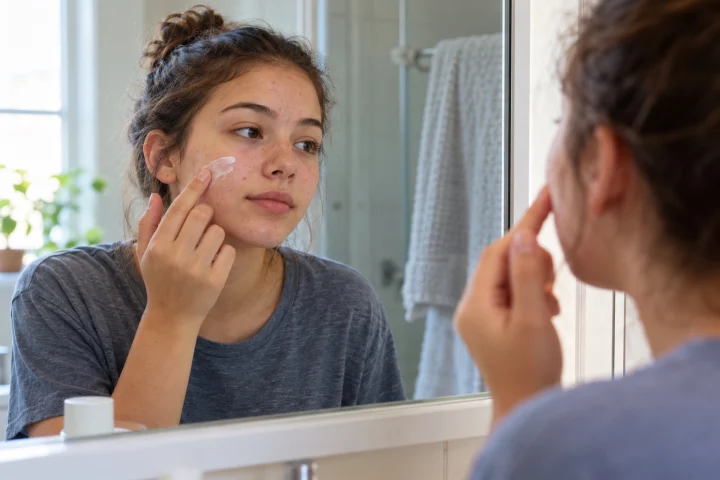
According to the AAD, touching your face throughout the day can make acne flare, and picking or popping raises the risk of scars. Notice when you rest your chin on your hand in class, or pick at a spot while you scroll. Those are the moments to catch.
3. Wear sunscreen every morning
The AAD recommends a broad-spectrum, water-resistant sunscreen with SPF 30 or higher, and says tanning can make acne worse. Look for one labeled “non-comedogenic” or “oil-free.”
4. Use products that won’t clog pores
Some makeup, sunscreens and skin and hair products contain oils that can cause breakouts. The AAD says to use only products labeled “non-comedogenic” or “won’t clog pores.”
And two makeup rules from the same list:
- Take it off before bed. No exceptions. Too tired to wash? A makeup remover wipe is better than nothing.
- Don’t share makeup, brushes or applicators.
5. Wash what touches your face
Hair products leave residue on everything your head touches. The AAD’s advice on hair products and acne is to wash pillowcases, sheets, caps, hats, headbands and visors. Breakouts along your hairline or forehead are a common clue. The AAD also says to shampoo regularly, because oil from your hair can cause acne on your forehead.
A simple habit: put a fresh pillowcase on once or twice a week.
6. Moisturize, even if you’re oily
Acne treatments dry out skin, and dry, irritated skin doesn’t heal faster. The AAD lists over-drying as one of the habits that can worsen acne, and recommends moisturizer after you wash. Pick a light, non-comedogenic one. Our 3-step skincare routine for teens shows how it all fits together.
7. Pick one treatment and stick with it
This is where most people go wrong. The AAD says to use an acne product for 6 to 8 weeks before you decide whether it works. Switching every week means nothing ever gets a chance.
Spread a thin layer over the whole area where you break out, not just on the pimples you can see right now. Not sure which treatment to start with? Read benzoyl peroxide vs salicylic acid, and for the stuff on your nose, how to get rid of blackheads.
What about food?
You’ve probably heard that chocolate or pizza causes acne. The science is more mixed than that. The AAD says that foods that make your blood sugar rise quickly, like white bread and fries, may worsen acne, and that several studies link cow’s milk to acne, though more research is needed. No studies have found that yogurt or cheese lead to more breakouts.
The AAD’s suggestion: pay attention to whether a specific food seems to trigger breakouts for you. And remember that a diet change alone won’t clear your skin.
When to see a dermatologist
If you’ve stuck with a treatment for 6 to 8 weeks and nothing has changed, it’s time to get help. Go sooner if you have deep, painful bumps, acne that leaves scars or dark marks, or breakouts that make you not want to go to school. A dermatologist can prescribe stronger treatments that work when drugstore products don’t.
Free printable tracker
Six to eight weeks is a long time. Check off your routine every day so you know you actually gave it a real try.
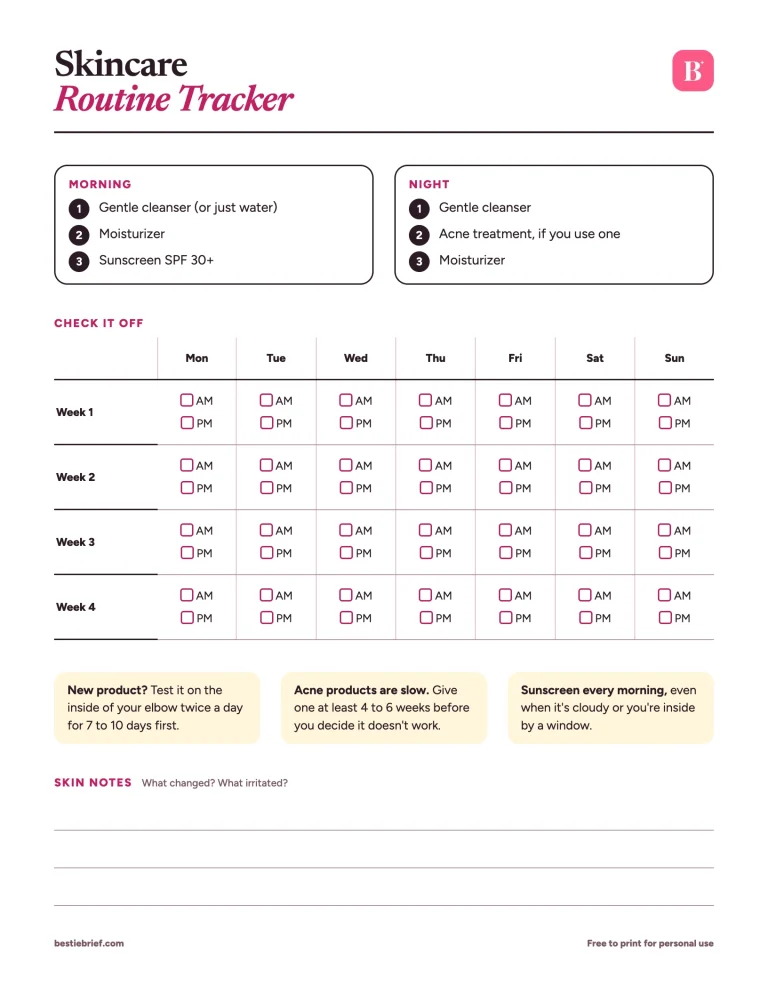
My First Skincare Routine Tracker
Three steps in the morning, three at night. Tape it next to your mirror and check off every day for four weeks.
Download the PDFOne page, letter size, prints fine in black and white.